
Inspiration Positive Transformations
I’m dedicated to elevating individuals by offering inspiration and creative guidance. As a parent, Iraq War Veteran, and documentary photographer, my mission is to inspire and empower you through my personal journey. My goal is to offer creative solutions and insights that will fuel your personal growth and success.
Label
Against All Odds: A Journey Through the Skies
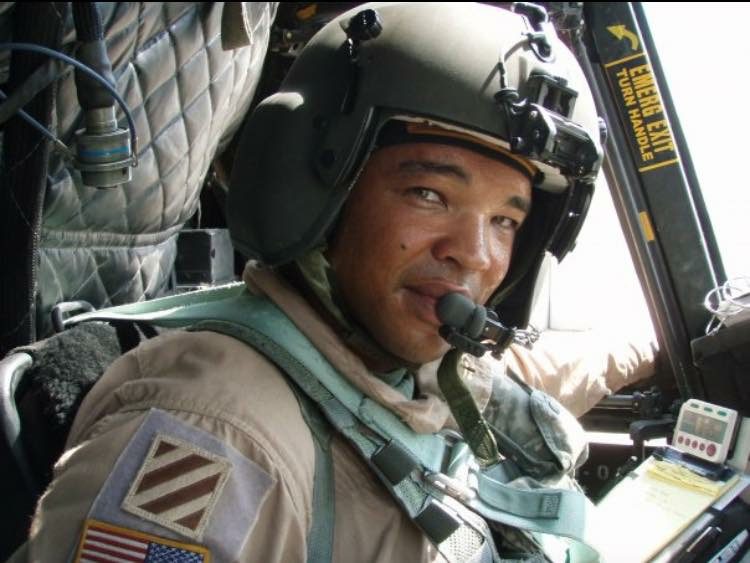
The first time I walked the flight line toward that massive CH-47D Chinook, its twin rotors casting shadows like mechanical wings, I knew I was different. Not just different—I was often the only one. Whether it was my background, my perspective, or simply the path that led me there, I found myself standing apart in a sea of uniforms, carrying the weight of representation while trying to prove I belonged in the pilot-in-command seat of a 33,000-pound tandem-rotor beast.
Label
Finding My Wings Among Strangers
The Chinook doesn't care about your zip code or your story—it demands excellence from everyone who dares to master its complex flight characteristics. My squadrons became a melting pot of humanity: farm kids from Iowa working alongside city dwellers from Detroit, immigrants chasing the American dream side by side with third-generation military families. We had accents from Boston to Baton Rouge, backgrounds spanning from privilege to poverty, and dreams as diverse as our origins.
But when those twin T55 engines spun up and the mission called, those differences dissolved. The Chinook became our common language, the mission our shared purpose. I learned that diversity wasn't just about checking boxes—it was about having the crew chief from Puerto Rico spot a hydraulic leak during preflight that others missed, or the flight engineer from rural Montana find a landing zone in terrain that seemed impossible to navigate.
Label
Pressure at the Controls
The pressure of flying a CH-47D as pilot-in-command is unlike anything else. Split-second decisions with thirty-three tons of aircraft and precious cargo hanging in the balance. Whether it was a routine training flight that suddenly turned into an emergency autorotation, or a combat mission where every detail mattered, the margin for error was always razor-thin. Being "the only one" in high-pressure situations meant carrying an invisible burden—knowing that my performance reflected not just on me, but on everyone who looked like me or came from where I came from.
As a test pilot, the pressure intensified exponentially. Flying experimental flight profiles, pushing aircraft systems to their limits, documenting performance parameters that would affect every Chinook that followed. I remember test flights where the weight of responsibility felt heavier than my survival gear. Radio chatter from the test engineers, instruments requiring constant monitoring, weather challenging every test card we'd planned. In those moments, muscle memory and training took over. The countless hours of preparation, the emergency procedures drilled until they became instinct, the understanding of every system from the transmission to the hydraulics—that's what separated successful test completion from catastrophic failure.
Label
From Peaceful Skies to Combat Zones
Flying the Chinook over Iraq revealed the aircraft's true purpose and my role in something larger than myself. The distinctive whop-whop-whop of twin rotors became a sound of hope for ground forces awaiting resupply, medical evacuation, or extraction. Every mission carried the knowledge that the troops we inserted, the supplies we delivered, or the wounded we evacuated could mean the difference between soldiers coming home or not. The CH-47's ability to carry heavy loads in hot, high-altitude conditions made it indispensable but also made every flight a complex calculation of weight, balance, power margins, and threat assessment.
Korea brought different challenges—political tensions that could shift with the wind, weather that tested both aircraft and crew limits, and the constant awareness of our proximity to one of the world's most volatile borders. The mountainous terrain demanded precision flying, often in conditions where the Chinook's size became both an asset and a liability. Dense fog, sudden weather changes, and confined landing zones required every bit of skill I'd developed as both pilot-in-command and test pilot.
Label
Home and Away: Two Different Battles
Serving abroad taught me that adversity has many faces. Overseas, it was obvious—language barriers, unfamiliar terrain, threats both seen and unseen. But returning home brought its own challenges. Readjusting to routine, carrying experiences that few could understand, and often returning to the same environment where I remained "the only one."
Each deployment, each return, each new assignment required adaptation. Building trust with new crews, proving competence in new roles, and maintaining the mental fortitude to perform when stakes were highest. The aircraft might change, the missions might evolve, but the fundamental challenge remained: excellence under pressure, regardless of the obstacles.
Label
Lessons Learned at Altitude
My aviation career taught me that adversity isn't an obstacle—it's a teacher. Being the minority in my field forced me to work harder, communicate better, and lead by example. Working with people from every corner of America and beyond showed me that our differences are our strengths when we're united by common purpose.
The cockpit of a CH-47D became my classroom for leadership, the flight line my laboratory for innovation, and every mission a test of character. Whether navigating through sandstorms over the Iraqi desert, coordinating with international allies in complex airspace, or making split-second decisions during emergency procedures, I learned that pressure reveals who you really are. As a test pilot, this pressure was magnified—every flight potentially writing the book on what the aircraft could or couldn't do, every data point contributing to the safety of future crews.
In the CH-47D, your background might get you to the starting line, but your performance keeps you in the pilot-in-command seat. The Chinook doesn't care about your story until you prove you can handle its unique flight characteristics, manage its complex systems, and make the split- second decisions that heavy-lift operations demand. And once you do, once you've earned your place at the controls of this mechanical workhorse, you realize that every challenge you overcame to get there wasn't just about you—it was preparation for the moment when ground forces would depend on your ability to get them out of harm's way, when test data you collected would keep future crews safe, and when your skill would mean the difference between mission success and failure.
Label
The Continuing Flight
Today, as I reflect on countless flight hours over Iraq and Korea, on test flights that pushed the envelope of what the CH-47D could do, and on missions where lives depended on precision flying, I understand that my journey was never just about overcoming adversity—it was about transforming that adversity into the kind of steadiness and skill that heavy-lift helicopter operations demand. Every time I was the only one in the briefing room or on the flight line, I had the opportunity to change perceptions, to build bridges, and to prove that excellence in commanding a Chinook comes in many forms.
The lessons learned at the controls continue to guide me: preparation conquers fear, diversity strengthens crews, and pressure either breaks you or forges you into the kind of pilot who can handle thirty-three tons of aircraft in the most demanding conditions. In the CH-47D, as in life, it's not about the turbulence you encounter—it's about how you manage the aircraft through it.
Explore My Approach
Discover how I can support your personal and professional growth through unique motivational talks and creative services.